
HR Manager
Employee development has become one of the defining priorities for organisations in 2026. In an increasingly dynamic business environment shaped by digital transformation, evolving workforce expectations, and competitive talent markets, companies can no longer rely solely on recruitment to maintain growth. They must continuously invest in developing the capabilities, leadership potential, and adaptability of their workforce.
Modern employees seek more than compensation. They want career progression, learning opportunities, mentorship, and long-term professional growth. Organisations that actively support employee development not only improve workforce performance but also strengthen retention, engagement, and organisational resilience.
This article explores the significance of employee development, its benefits, the major stages involved, and strategies organisations can adopt to create sustainable workforce growth.
What is Employee Development?
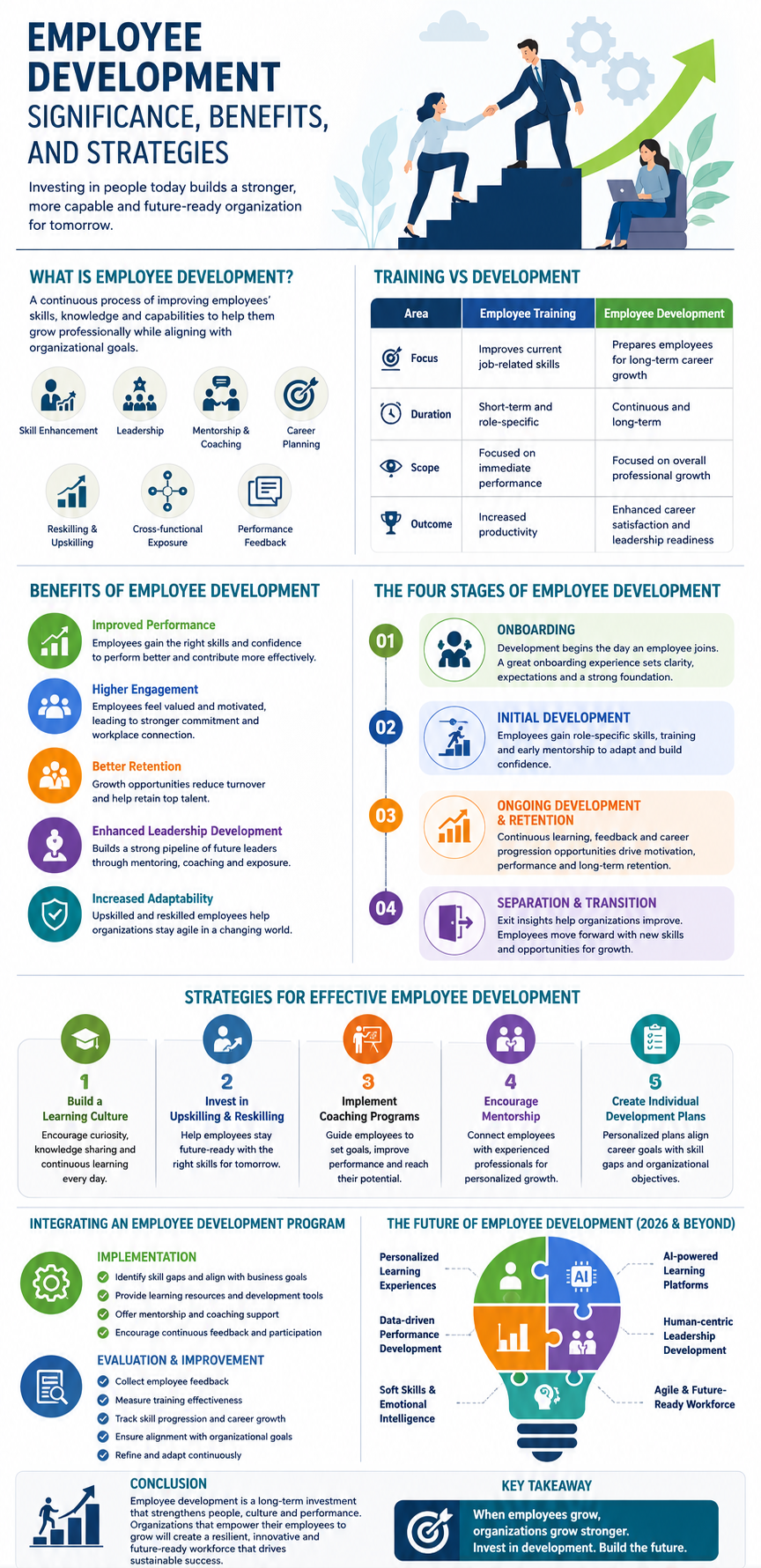
Employee development refers to the continuous process of improving employees’ skills, competencies, knowledge, and career capabilities to help them grow professionally while aligning with organisational objectives.
It is a long-term strategic initiative that goes beyond traditional job training. Employee development focuses on preparing employees not just for their current responsibilities but also for future roles, leadership opportunities, and changing business demands.
Effective employee development typically includes:
- Skill enhancement programs
- Leadership development initiatives
- Mentorship and coaching
- Career path planning
- Reskilling and upskilling
- Cross-functional exposure
- Performance feedback systems
Organisations that prioritise employee development often create stronger workplace cultures built on continuous learning and growth.
Employee Training vs Employee Development
Although employee training and employee development are closely connected, they serve different purposes.
| Area | Employee Training | Employee Development |
|---|---|---|
| Focus | Improves current job-related skills | Prepares employees for long-term career growth |
| Duration | Short-term and role-specific | Continuous and long-term |
| Scope | Focused on immediate performance | Focused on overall professional growth |
| Outcome | Increased productivity | Enhanced career satisfaction and leadership readiness |
Why Employee Development Matters in Modern Organisations
Employee development is no longer optional for businesses aiming to remain competitive. As industries evolve rapidly due to technology adoption, automation, AI integration, and changing consumer expectations, organisations need adaptable and future-ready teams.
A strong employee development culture helps organisations:
- Build leadership pipelines
- Reduce skill gaps
- Improve employee engagement
- Strengthen innovation capabilities
- Increase organisational agility
- Improve succession planning
- Enhance employer branding
For employees, development initiatives create a sense of purpose, career direction, and confidence, leading to stronger commitment and long-term organisational loyalty.
Benefits of Employee Development
1. Improved Employee Performance
Development programs help employees strengthen both technical and soft skills. Better-equipped employees perform their roles more efficiently, make stronger decisions, and contribute more effectively to organisational goals.
Continuous learning also increases employee confidence, enabling individuals to handle responsibilities with greater accountability and independence.
2. Higher Employee Engagement
Employees are more engaged when organisations demonstrate genuine investment in their professional growth. Development initiatives create a sense of value and recognition, improving emotional connection with the workplace.
Engaged employees are more collaborative, proactive, and committed to organisational success.
3. Better Employee Retention
Career stagnation is one of the primary reasons employees leave organisations. When companies provide clear growth opportunities, employees are more likely to remain loyal.
Organisations that invest in employee development often experience reduced turnover costs, improved workforce stability, and stronger institutional knowledge retention.
4. Enhanced Leadership Development
Future leadership cannot be built overnight. Employee development programs help identify high-potential individuals and prepare them for leadership responsibilities through mentoring, coaching, and strategic exposure.
This creates a sustainable internal leadership pipeline.
5. Increased Organisational Adaptability
Modern businesses must constantly adapt to technological and market changes. Development programs focused on reskilling and upskilling ensure employees remain capable of navigating evolving business environments.
This improves organisational resilience and long-term competitiveness.
The Four Stages of Employee Development
Employee development can be viewed as a continuous lifecycle consisting of four key stages.
1. Onboarding
Employee development begins during onboarding. A structured onboarding experience helps employees understand organisational culture, responsibilities, expectations, and performance standards.
Effective onboarding accelerates learning, improves confidence, and supports smoother integration into the workplace.
A positive onboarding experience also lays the foundation for long-term engagement and career growth.
2. Initial Development
Once onboarding is complete, organisations focus on developing role-specific competencies.
This stage often includes:
- Technical training
- Process understanding
- Early mentorship
- Team integration
- Skill development workshops
The objective is to help employees quickly adapt to their responsibilities while building the confidence required for long-term success.
3. Ongoing Development and Retention
Employee development is most effective when it becomes continuous rather than occasional.
Ongoing development includes:
- Leadership programs
- Cross-functional projects
- Advanced certifications
- Performance coaching
- Career progression planning
- Continuous learning initiatives
This stage strengthens employee motivation, improves retention, and creates a culture of growth and innovation.
4. Separation and Transition
Even employee exits can contribute to organisational learning and development.
Exit feedback provides valuable insights into:
- Workplace culture
- Leadership effectiveness
- Burnout issues
- Career growth gaps
- Employee expectations
This stage helps organisations refine development strategies while enabling employees to continue their professional growth in new environments.
Strategies for Effective Employee Development
1. Build a Learning Culture
Employee development should not be limited to formal training sessions. Organisations must create a culture where learning becomes part of everyday work.
This includes:
- Encouraging curiosity
- Supporting experimentation
- Promoting knowledge sharing
- Recognising learning achievements
A learning-driven environment encourages continuous improvement across all levels of the organisation.
2. Invest in Upskilling and Reskilling
Rapid technological advancement requires employees to continuously update their capabilities.
Upskilling helps employees improve existing competencies, while reskilling prepares them for entirely new responsibilities or business functions.
Organisations that prioritise workforce adaptability remain more competitive in changing markets.
3. Implement Coaching Programs
Coaching helps employees improve performance, build confidence, and achieve career goals through structured guidance.
Effective coaching:
- Enhances accountability
- Improves decision-making
- Develops leadership skills
- Supports career progression
Coaching programs are especially valuable for emerging leaders and high-potential employees.
4. Encourage Mentorship
Mentorship creates personalised growth opportunities by connecting employees with experienced professionals.
Strong mentorship programs support:
- Career guidance
- Leadership readiness
- Skill development
- Organisational integration
- Professional confidence
Mentorship also strengthens collaboration and knowledge transfer within organisations.
5. Create Individual Development Plans
Every employee has unique career aspirations and development needs.
Individual development plans help organisations personalise growth initiatives by defining:
- Career objectives
- Skill gaps
- Learning opportunities
- Development timelines
- Performance expectations
This approach increases employee ownership and alignment with organisational goals.
Integrating an Employee Development Program
Successfully implementing employee development requires strategic planning and continuous evaluation.
Implementation
Organisations should begin by:
- Identifying workforce skill gaps
- Aligning development goals with business objectives
- Providing learning resources and tools
- Offering mentorship and coaching support
- Encouraging continuous feedback
Leadership involvement is essential in creating credibility and participation across the organisation.
Evaluation and Improvement
Employee development strategies must evolve continuously.
Organisations should regularly evaluate:
- Employee feedback
- Training effectiveness
- Skill progression
- Retention improvements
- Leadership readiness
- Organisational impact
Continuous refinement ensures development programs remain relevant to changing business and workforce needs.
The Future of Employee Development in 2026
Employee development is evolving rapidly due to AI adoption, hybrid work models, automation, and digital transformation.
Modern organisations are increasingly focusing on:
- Personalised learning experiences
- AI-powered learning platforms
- Data-driven performance development
- Human-centric leadership development
- Soft skills enhancement
- Emotional intelligence training
- Agile workforce capabilities
Conclusion
Employee development is one of the most powerful long-term investments an organisation can make. It strengthens workforce capabilities, improves retention, develops future leaders, and creates sustainable organisational growth.
Businesses that focus on continuous learning and career development build resilient teams capable of adapting to evolving market demands. More importantly, they create workplace environments where employees feel valued, empowered, and motivated to contribute their best.
In a competitive talent landscape, organisations that actively invest in employee development will continue to outperform those that treat workforce growth as an afterthought.
Building people ultimately builds stronger businesses.
FAQs
What is employee development?
Employee development is the continuous process of improving employees’ skills, knowledge, and career capabilities to support both individual growth and organisational success.
Why is employee development important?
Employee development improves performance, increases engagement, enhances retention, builds leadership pipelines, and prepares organisations for future challenges.
What is the difference between employee training and employee development?
Training focuses on improving current job-related skills, while development focuses on long-term career growth and future organisational roles.
What are common employee development strategies?
Common strategies include training programs, mentorship, coaching, leadership development, reskilling, upskilling, and personalised learning plans.
How does employee development improve retention?
Employees are more likely to stay with organisations that invest in their career growth, learning opportunities, and professional advancement.