

HR Executive
In today’s rapidly evolving business landscape, organizations expect more than task completion—they seek individuals who own their work with clarity, confidence, and conviction. Taking ownership means going beyond assigned duties, demonstrating accountability, and acting with a mindset aligned to organizational goals. It is one of the strongest indicators of leadership potential and a highly valued trait among top-performing professionals.
At Shrofile, one of India’s leading executive search and HR consulting firms, we work closely with organizations to build cultures where ownership, accountability, and empowerment thrive. Such environments not only unlock individual excellence but also create teams that consistently deliver business impact.
This article explores why ownership at work matters, the benefits it brings to employees and organizations, and practical steps leaders can take to nurture this mindset.
Why Is Taking Ownership in the Workplace Important?
Encouraging employees to take ownership is essential for developing an engaged, responsible, and future-ready workforce. Here’s why it matters:
- Creates a Positive Work Atmosphere: Teams with strong ownership mindsets build a culture of respect, reliability, and mutual support.
- Increases Motivation and Excitement: Ownership boosts intrinsic motivation and commitment toward meaningful goals.
- Encourages Skill Development: Taking responsibility pushes employees to learn continuously and expand their abilities.
- Supports Career Growth: Ownership-oriented employees grow faster and are better suited for leadership roles.
Benefits of Taking Ownership at Work
- Boosts Productivity: Ownership drives proactive planning, faster execution, and higher performance.
- Enhances Problem-Solving: Employees who take ownership analyse challenges deeply and find effective solutions.
- Builds Trust and Credibility: Consistent ownership earns confidence from colleagues and leaders.
- Drives Innovation: Empowered employees experiment, improve processes, and bring forward creative ideas.
- Strengthens Team Collaboration: Ownership improves alignment with team goals and enhances communication.
Effective Ways to Build a Culture of Ownership
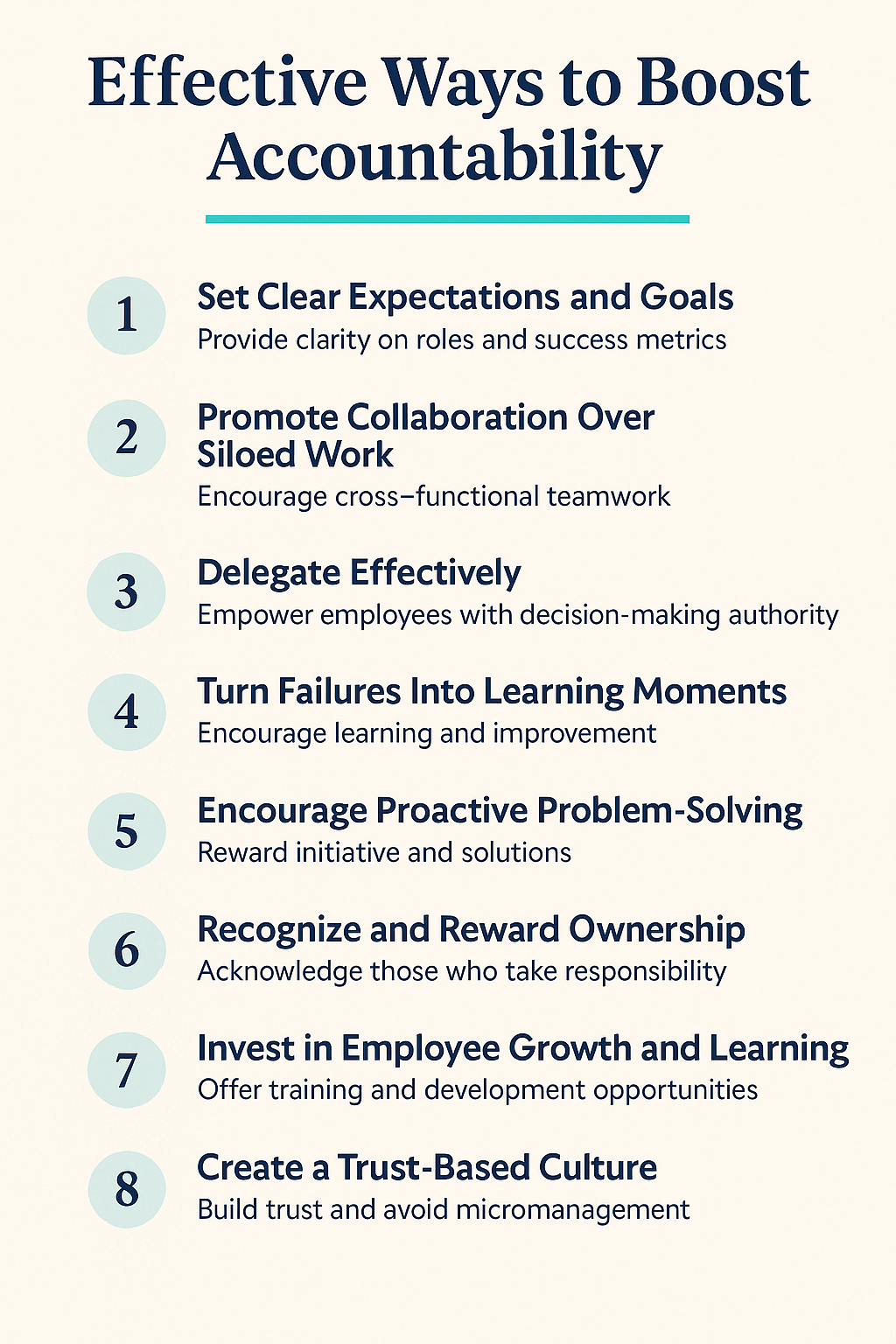
- Set Clear Expectations and Goals: Clear roles and success metrics eliminate confusion and enable ownership.
- Promote Collaboration Over Siloed Work: Cross-functional teamwork builds shared accountability.
- Delegate Effectively: Empower employees to make decisions and take complete responsibility.
- Turn Failures Into Learning Moments: Encourage learning and improvement rather than blame.
- Encourage Proactive Problem-Solving: Reward initiative and solution-oriented thinking.
- Recognize and Reward Ownership: Acknowledge employees who consistently take responsibility.
- Invest in Employee Growth and Learning: Provide training and development to build confidence and capability.
- Create a Trust-Based Culture: Trust inspires responsibility; micromanagement restricts it.
Conclusion
Taking ownership is not just a behavioural trait—it is a mindset that transforms individuals and organizations. When employees feel empowered and trusted, they take responsibility for results, solve problems proactively, and contribute meaningfully to business growth.
For organizations, this means stronger teams, better leadership pipelines, and a culture where innovation thrives. As an executive search and leadership hiring partner, Shrofile continues to support companies in building high-performance environments rooted in accountability and responsibility.
Looking to hire leaders who take ownership and drive lasting impact?
Connect with Shrofile’s Executive Search Experts →
FAQs
1. What does taking ownership at work really mean?
It means accepting responsibility for actions, outcomes, and decisions—even when things go wrong.
2. How do I show ownership in daily tasks?
Meet deadlines, solve problems, communicate proactively, and continuously improve your work.
3. Can ownership be taught?
Yes. With clarity, empowerment, training, and recognition, employees can develop an ownership mindset.
4. Why do companies value ownership so much?
Because it boosts productivity, builds trust, and accelerates leadership readiness.
5. How does ownership support leadership growth?
Employees who take ownership naturally develop responsibility, credibility, and decision-making skills—core qualities of strong leaders.