

HR Manager
The way organisations succeed has fundamentally changed. In boardrooms and C-suites across industries, one question surfaces repeatedly: why do some leadership teams consistently outperform while others — equally talented on paper — struggle to deliver? The answer, more often than not, lies not in individual brilliance, but in the quality of collaboration at the top.
At Shrofile Executive Search, we have spent years placing leaders across sectors. The single greatest differentiator we observe between thriving organisations and stagnant ones is not strategic vision alone, nor technical expertise. It is the ability of senior leaders to build, sustain, and model high-performing teams. Workplace teamwork — especially at the executive level — is no longer a soft skill. It is a strategic capability.
This article explores why teamwork in the workplace has never mattered more, what is causing it to break down in hybrid and distributed environments, and — most critically — what exceptional leaders are doing to rebuild it.
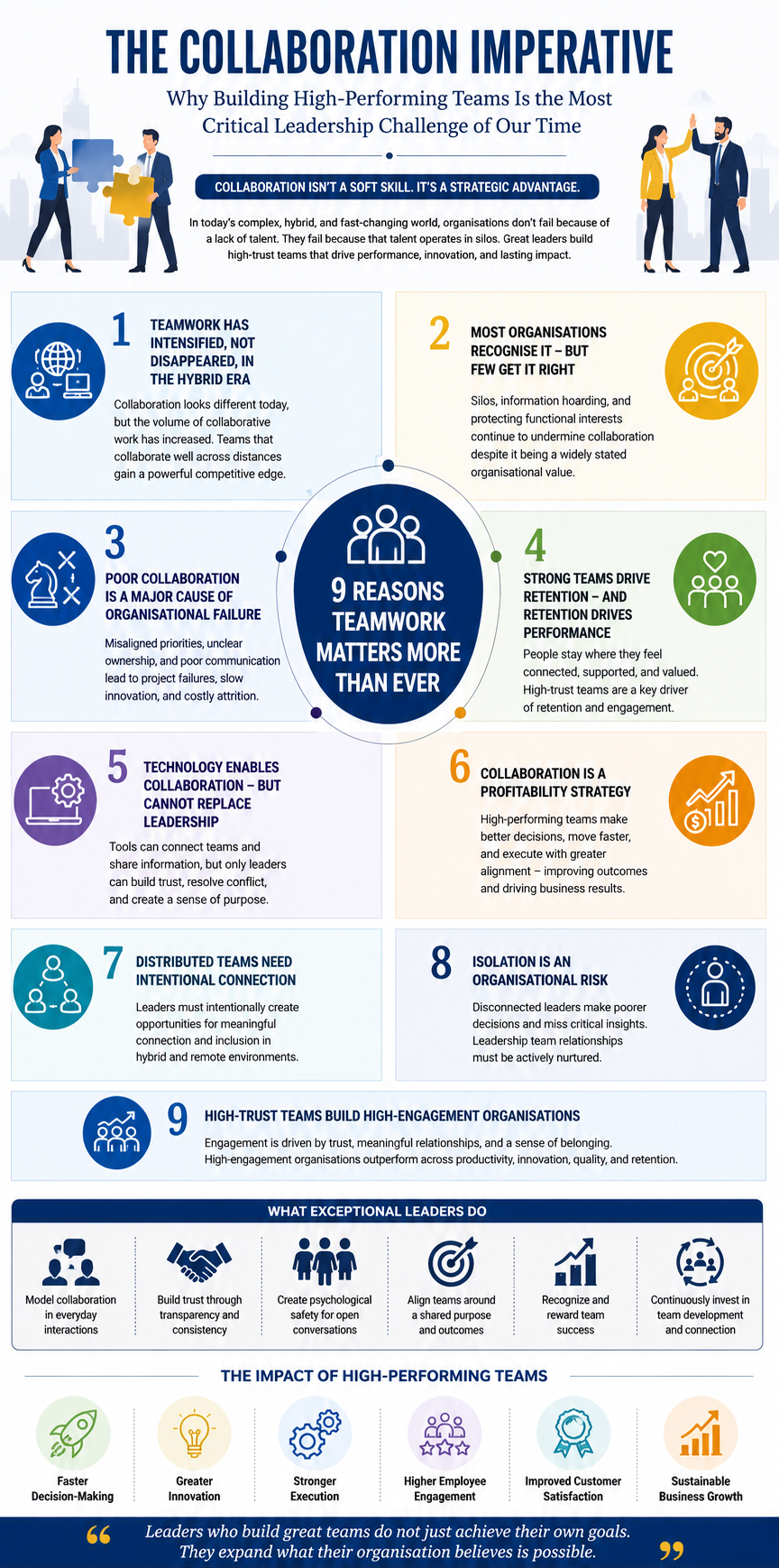
1. Teamwork Has Intensified, Not Disappeared, in the Hybrid Era
A common misconception following the widespread shift to remote and hybrid work was that collaboration would naturally decline. The opposite has proven true. Research consistently shows that employees today spend a significant portion of their working week engaged in collaborative activity — meetings, cross-functional coordination, digital communication, and shared decision-making. The volume of collaborative work has grown; what has changed is the environment in which it takes place.
For executive leaders, this creates both an opportunity and a risk. Teams that develop the discipline to collaborate effectively across physical distances and time zones gain a powerful competitive advantage. Those that do not find themselves losing alignment, slowing execution, and struggling with talent retention.
The transition from spontaneous, face-to-face collaboration to structured, intentional teamwork requires a deliberate shift in leadership behaviour. Senior executives must become architects of collaboration — designing team structures, communication rhythms, and shared accountability frameworks that make great teamwork possible regardless of where people sit.
The leaders who will define the next decade are not those who manage individuals — they are those who engineer environments where great teams thrive.
2. Most Organisations Recognise It — But Few Get It Right
Ask any executive whether teamwork matters, and the answer is an unequivocal yes. Across industries, collaboration is rated as a core organisational value and a critical success factor for achieving business goals. Many companies embed it in their employer value propositions, leadership competency frameworks, and performance review criteria.
Yet the lived experience of employees tells a more complicated story. Silos persist. Functional leaders protect their domains. Information is withheld rather than shared. Decisions that could benefit from cross-functional input are made unilaterally. The gap between stated values and daily behaviours remains one of the most damaging inconsistencies in organisational culture.
From an executive search perspective, this gap often starts at the top. When organisations hire senior leaders primarily on individual achievement — technical mastery, a strong track record, a prestigious pedigree — without rigorously assessing their capacity to collaborate, build trust, and elevate those around them, the culture that follows reflects those priorities.
The most progressive organisations we work with have reversed this equation. They screen for collaborative leadership capability as a non-negotiable criterion, not an afterthought. They assess how candidates have built team cultures, navigated conflict constructively, and created conditions for diverse perspectives to surface and be heard.
3. Poor Collaboration Remains the Single Biggest Cause of Organisational Failure
Project failures, missed targets, slow innovation, and costly attrition rarely have a single cause. But when you trace the root, poor communication and fragmented teamwork appear again and again. Misaligned priorities, unclear ownership, and the absence of psychological safety all compound over time into serious organisational problems.
In environments that depend on cross-functional execution — which today includes virtually every large organisation — the consequences of weak collaboration are amplified. A product team delivering excellent technical work can still fail if marketing, sales, and customer success are not integrated into the process. A strategy can be perfectly conceived and poorly executed because the leaders responsible never fully aligned.
For boards and CEOs assessing executive performance, this is a critical insight: the leader whose team consistently misses interdependencies, creates friction with peers, or fails to bring stakeholders along may not have a strategy problem. They may have a collaboration problem. Identifying this clearly — and addressing it through leadership development or, when necessary, leadership change — is one of the highest-value decisions an organisation can make.
Organisations do not fail because of a lack of talent. They fail because that talent operates in silos.
4. Strong Teams Drive Retention — And Retention Drives Performance
Compensation attracts people. Culture keeps them. And at the heart of culture is the daily experience of working alongside colleagues — the quality of relationships, the sense of belonging, and the feeling of being part of something meaningful.
In a talent market where top executives have more options than ever, organisations that fail to build genuinely connected, high-trust teams are directly undermining their retention. Senior professionals who feel isolated, unsupported, or surrounded by political dynamics do not stay — no matter how competitive the package.
This is not sentiment. It has direct financial consequences. The cost of replacing a senior executive — in fees, onboarding time, lost momentum, and disruption to team cohesion — is substantial. Organisations that invest in creating environments where leaders genuinely enjoy working together, feel psychologically safe, and experience a shared sense of purpose retain talent at significantly higher rates.
When we counsel organisations on executive retention, we consistently point to three factors that matter most to senior leaders beyond compensation: the quality of their peers, the clarity of their mandate, and the culture of their immediate team. All three are direct expressions of how well teamwork is functioning at the top.
5. Technology Enables Collaboration — But Cannot Replace Leadership
The rapid adoption of workplace technology since 2020 has transformed how distributed teams stay connected. Communication platforms, project management tools, shared workspaces, and employee experience applications have all become standard infrastructure for modern organisations.
Yet technology is an enabler, not a solution. We see organisations invest significantly in digital tools and still struggle with collaboration, because the underlying behaviours, norms, and leadership practices have not changed. Tools can surface information and reduce friction — but they cannot build trust, resolve conflict, or create a shared sense of purpose. Only people can do that.
The most effective executive teams we observe use technology intentionally and selectively. They agree on how they will communicate, what tools they will use for which purposes, and how they will protect space for the kinds of unstructured, candid conversations that technology cannot replicate. How a leader builds connection across a distributed team — through structured communication, virtual presence, and consistent follow-through — is now as important as how they lead in person.
The best tools in the world cannot compensate for leaders who do not know how to create trust.
6. Collaboration Is a Profitability Strategy, Not a Cultural Nicety
There is a persistent tendency to frame teamwork as a cultural or human resources priority — important for engagement and wellbeing, but separate from commercial performance. This framing is not just outdated; it is strategically dangerous.
The evidence is unambiguous: organisations with highly connected, collaborative teams consistently outperform peers on productivity, innovation, and financial results. When leaders are aligned, decisions are faster and better. When teams share context and build on each other’s thinking, solutions are more creative and more executable. When trust is high, the transaction costs of internal coordination drop significantly.
For boards, investors, and CEOs, this should reframe how leadership effectiveness is evaluated. A senior leader who consistently achieves individual results while damaging peer relationships, hoarding information, or creating internal friction is not a high performer. They are a liability. At Shrofile, we advise organisations to integrate collaborative impact metrics into executive performance frameworks — making teamwork visible, measured, and consequential.
7. Building Connection in Distributed Teams Requires Intentional Design
The informal bonds that once formed naturally in shared office environments do not emerge automatically in distributed settings. Water-cooler conversations, spontaneous lunches, and the ambient social fabric of physical workplaces all contributed to trust-building that leaders once took for granted. In hybrid and remote organisations, that infrastructure is largely absent.
The leaders who navigate this best treat connection as a design challenge. They create regular, structured opportunities for their teams to interact beyond task-level coordination. They invest in shared experiences that build relationships and reinforce a common identity and purpose. They are intentional about inclusion, ensuring that remote and hybrid team members are not inadvertently marginalised by proximity bias.
This is not about mandatory fun or performative team-building. It is about the serious work of maintaining the human infrastructure that underpins collective performance. Executive leaders who dismiss this as soft are, in our experience, the same leaders whose teams show the highest turnover and lowest engagement scores.
8. Isolation Is an Organisational Risk, Not an Individual Problem
One of the most underacknowledged risks in modern organisations is the slow erosion of connection among senior leaders themselves. As executives become more dispersed, more time-pressured, and more reliant on asynchronous communication, the quality of their peer relationships often deteriorates quietly.
The consequences are serious. Isolated leaders make poorer decisions. They lack the candid feedback loops that help them identify blind spots. They miss the informal intelligence that flows through strong peer networks. And they model isolation for the teams below them, creating cultures where disconnection is normalised.
Boards and CEOs have a responsibility to actively monitor the health of their leadership team’s internal relationships — not just the outcomes they produce. Early warning signs of a deteriorating top team dynamic — escalating tensions, information hoarding, or the absence of constructive challenge — should be treated with the same urgency as a financial risk.
9. High-Trust Teams Produce High-Engagement Organisations
Engagement is one of the most consequential and most elusive outcomes in organisational life. Highly engaged employees outperform their disengaged counterparts across every meaningful metric — productivity, quality, customer satisfaction, innovation, and retention. And yet, engagement remains stubbornly low across most industries globally.
The path to engagement runs directly through the quality of workplace relationships. People are engaged when they feel trusted, when they believe their contribution matters, when they experience genuine connection with colleagues, and when they are part of a team that holds itself to a high standard of mutual respect and accountability.
These are not abstract values. They are the outputs of specific leadership behaviours: leaders who give honest feedback and receive it gracefully; who share credit generously and take accountability seriously; who invest in the development of those around them; and who are consistently visible, present, and human — even across digital channels. When organisations hire, promote, and develop leaders who embody these behaviours, engagement is not a programme they have to run. It is a natural outcome of the culture they create.
Leaders who build great teams do not just achieve their own goals. They expand what their organisation believes is possible.
What This Means for Executive Search
At Shrofile Executive Search, these insights directly shape how we approach every mandate. We do not only search for leaders who have achieved impressive results — we search for leaders who have achieved those results by elevating the people and teams around them.
In our assessment process, we evaluate leadership capability across several critical dimensions:
- How has this leader built and sustained high-performing teams under pressure?
- What evidence exists of cross-functional influence and collaborative impact beyond their own function?
- How do they navigate disagreement and conflict within senior teams?
- What culture do they create for those who report to them, and how is that evidenced?
- How have they adapted their collaboration style for distributed and hybrid environments?
- How do former colleagues, peers, and direct reports describe working with them?
Finding the right leader is only half the equation. Ensuring they are positioned to succeed within a culture that genuinely values and rewards collaborative leadership is equally important.
Closing Thoughts
The organisations that will lead their industries in the years ahead will not be those with the most individual talent. They will be those that have learned how to harness collective intelligence — how to build environments where leaders trust each other, challenge each other, and consistently bring out each other’s best.
This requires deliberate choices: in who you hire, how you develop them, what you reward, and what you hold non-negotiable in your leadership culture. Teamwork at the executive level is not a given. It is an achievement — and it is one of the most powerful competitive advantages an organisation can build.
If your organisation is navigating a leadership transition, building a new executive team, or seeking to strengthen the collaborative capability of your senior leadership, Shrofile Executive Search is ready to help.
Great Organisations Are Built By Leaders Who Build Great Teams
The future belongs to organisations that can create high-trust, collaborative, and high-performing leadership teams. At Shrofile Executive Search, we help companies identify leaders who elevate culture, strengthen collaboration, and drive long-term business impact.
Frequently Asked Questions
What is teamwork in the workplace?
Teamwork in the workplace refers to employees and leaders working collaboratively toward shared organisational goals through communication, coordination, trust, and collective problem-solving.
Why is workplace teamwork important in 2026?
Workplace teamwork is increasingly important because organisations now operate in hybrid, distributed, and fast-changing environments where collaboration directly impacts productivity, innovation, employee engagement, and retention.
How do high-performing teams improve business performance?
High-performing teams improve decision-making, execution speed, innovation, communication, and cross-functional alignment. They also reduce organisational friction and improve employee retention.
What are the biggest challenges affecting collaboration today?
Common collaboration challenges include communication silos, lack of trust, hybrid work complexity, poor leadership alignment, unclear accountability, and weak cross-functional coordination.
Why is collaborative leadership important for executive teams?
Collaborative leadership helps executive teams align faster, build trust, improve strategic execution, and create stronger organisational cultures. Leaders who collaborate effectively typically drive better long-term business outcomes.
How does Shrofile evaluate collaborative leadership capability?
Shrofile Executive Search evaluates how leaders build teams, manage conflict, influence across functions, strengthen workplace culture, and create high-performing collaborative environments within organisations.